
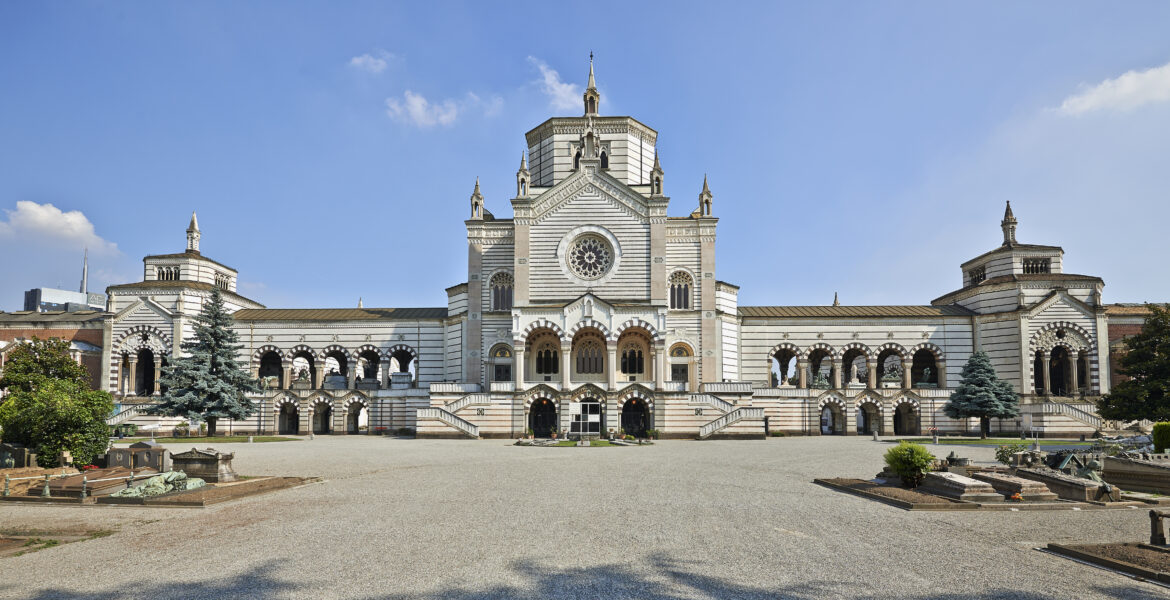
There is a place in Milan where the feverish pace of the metropolis grinds to a sudden halt, met by a monumental curtain of silence. The moment one steps through the gates of the Cimitero Monumentale, the din of urban traffic vanishes, replaced by long, tree-lined avenues that lead not so much to a graveyard as to an open-air museum of exceptional historical and critical value.
Inaugurated in 1866, the Monumentale was the brainchild of the architect Carlo Maciachini. Endowed with an extraordinary eclectic sensibility, Maciachini conceived a monumental facade that seamlessly blends Neo-Gothic and Pisan-Romanesque sensibilities, masterfully playing with the chromatic contrasts between the white of Botticino marble and the deep red of Simona stone. It is no coincidence that the designer’s own family rests within these walls, as if to seal an indissoluble bond between the author and his greatest work.
The union of artistic currents
To stroll through the various sections of the Monumentale today is to retrace the evolution of Italian sculpture from the nineteenth century to the present day. There are styles layer and intertwine without redundancy: from late-nineteenth-century realism to the audacities of Art Deco, right up to twentieth-century modernism. This way, the visitor’s eye is inevitably captured by works of monumental scale and visual daring, such as the famous Edicola Campari.
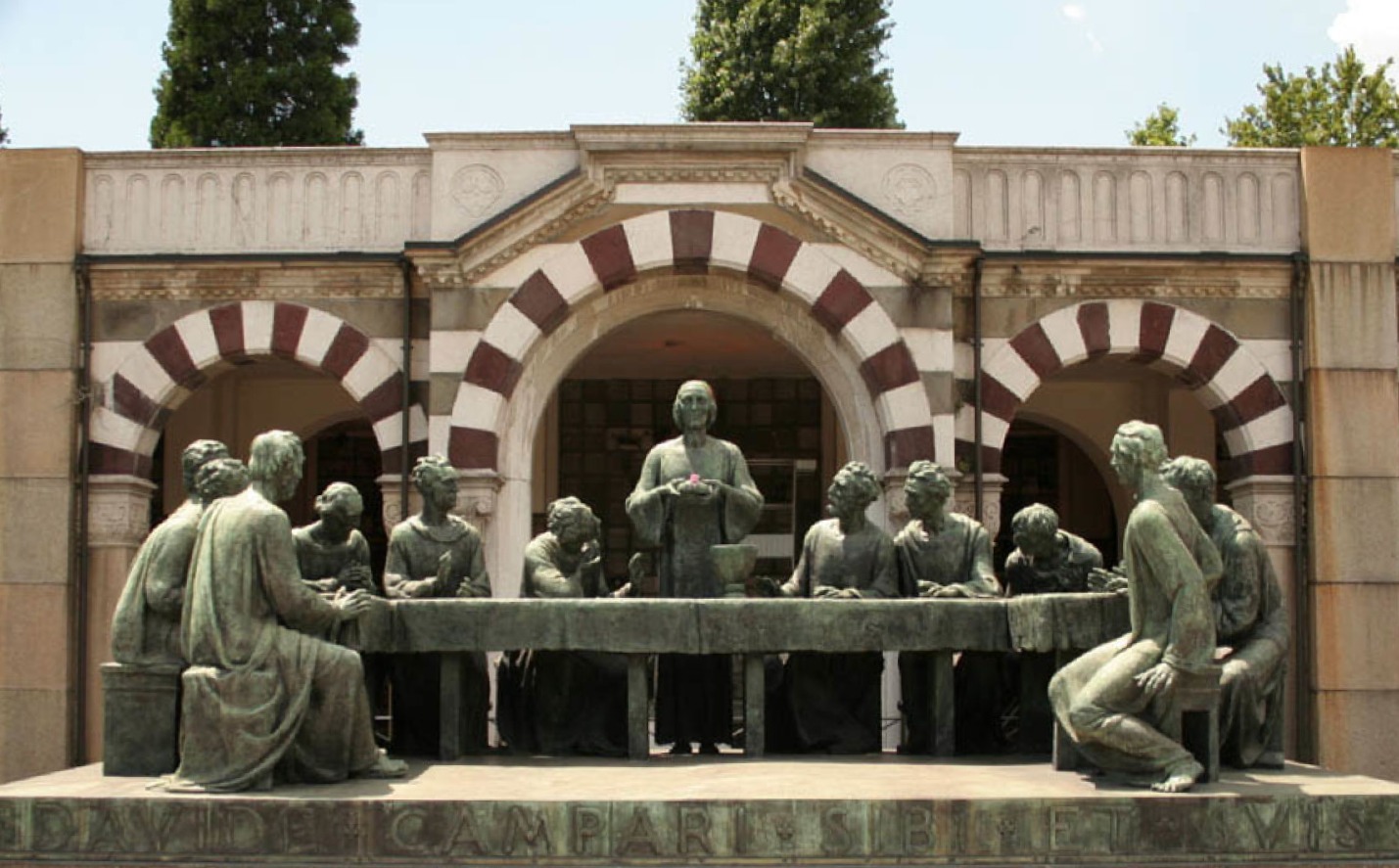
Here, the sculptor Giannino Castiglioni brought to life a gigantic, theatrical reinterpretation of the Last Supper in bronze, where the theatricality of the three-dimensional figures transforms a family tomb into a powerful art installation.
The names that made the history of Milan and our country
Yet, the Monumentale is far more than a catalogue of sculptural styles; it is, first and foremost, the social and cultural barometer of the true Milanese spirit. Walking along the avenues, one encounters the custodians of the city’s theatrical and musical soul. Here we can find the remains of Paolo Grassi, the historic founder of the Piccolo Teatro, rest a short distance from those of Giorgio Gaber. And standing in front of Gaber’s name, it is impossible not to feel the echo of that “teatro-canzone” which dissected Milan with such ironic and razor-sharp lucidity. Near the Gaber’s tomb, there is a more working-class, melancholic Milan resurfaces at the burial site of Enzo Jannacci, a genius at transforming the everyday life into pure poetry. And it is a lyricism that becomes more intimate when remembering Alda Merini, whose poetry vibrates amidst the light and shadow of the corridors.
Alongside the luminaries of culture and poetry, the Monumentale also preserves the icons of the city’s secular and sporting identity. Enthusiasts will find here the memory of Milanese football’s origins: the tomb of Herbert Kilpin, the english pioneer who founded AC Milan in 1899, and the tribute to Giuseppe Meazza, eternal symbol of Milanese football. And in this ideal pantheon of Milan’s footballing memory, Cesare Maldini could hardly be missing.
Where Memory Becomes Eternal
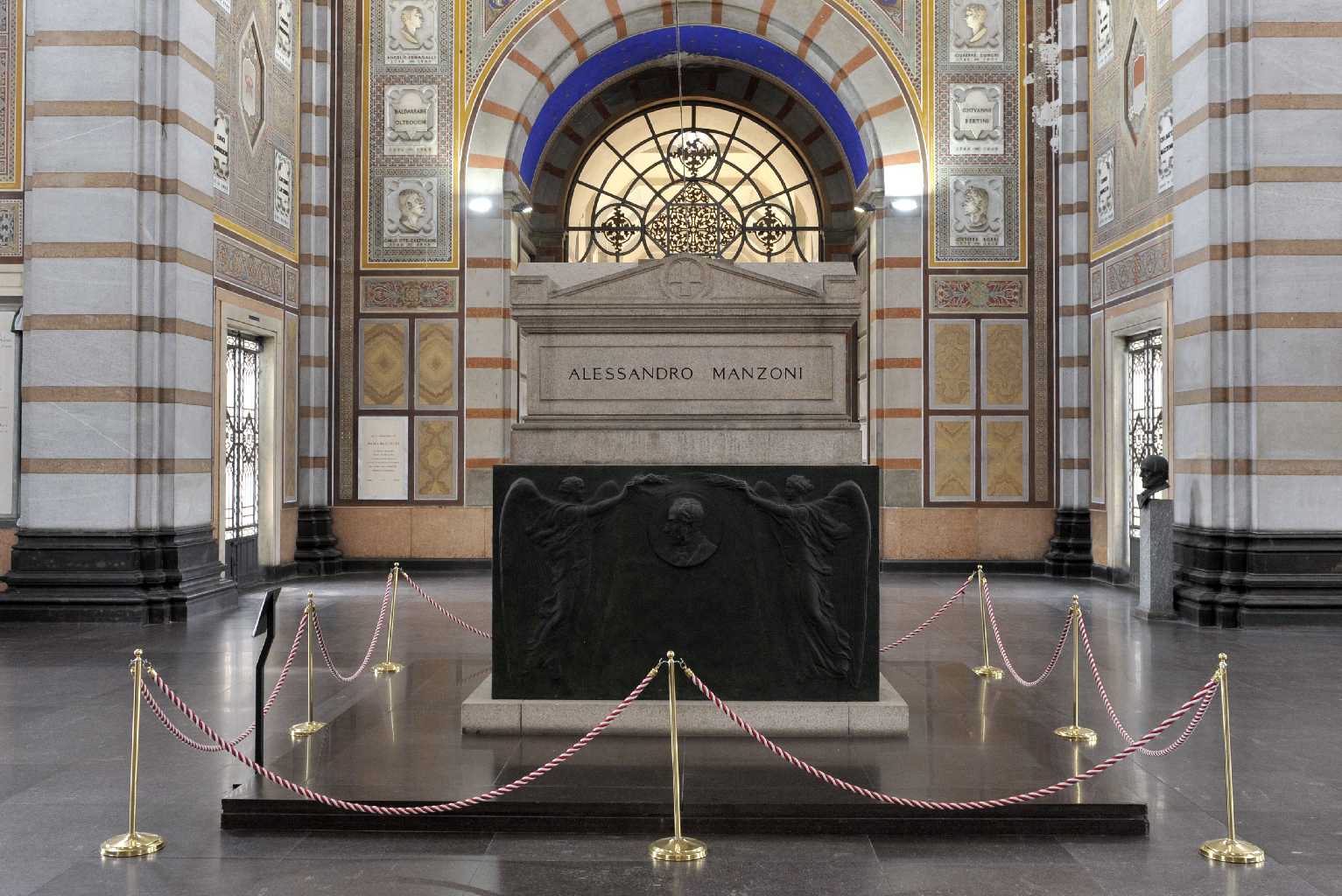
The journey within this artistic perimeter finds its natural, linear conclusion in the Famedio, the true temple of civic fame. This imposing building, dominated by a crypt and solemn spaces, is the beating heart of collective memory. Furthermore, at the exact center of the space stands the tomb of Alessandro Manzoni, the cardinal point. Surrounding the author of The Betrothed are the great minds that built Italian modernity, from science to literature. There are figures of the caliber of Carlo Forlanini, a pioneer of medicine, or the Nobel Laureate for literature, Salvatore Quasimodo.
Leaving Maciachini’s grandiose facade behind, Milan abruptly resumes its customary, frenetic pace. And yet, after traversing the geometric and cultured tranquility of these avenues, the metropolis seems to reveal a different face. Less ephemeral, decidedly more human, and, through the lens of art, decisively more eternal.
