
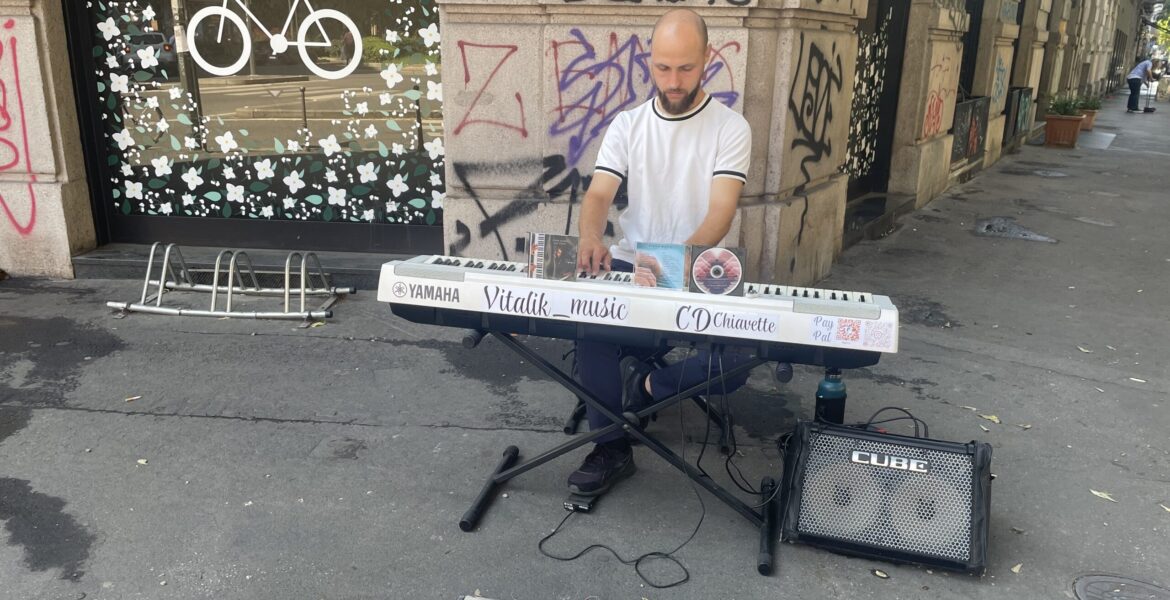
We were walking towards Isola when we came across Vitalik. He was playing his small Yamaha keyboard outside a supermarket, at the corner of Via Plinio and Via Eustachi. “What can I play for you, guys?”, he asked. The melody was sad and at times melancholic, in stark contrast with the morning frenzy of the neighbourhood. The longer we watched him, the more captivated we became. Spread out on the ground in front of the keyboard was a collection of CDs. We later came to know that they had all been composed by him.
When the music stopped, we started talking to him. We found out that Vitalik was Ukrainian, born in Kiev. There he studied Music, in a Conservatory. He came to Italy 9 years ago, and then he got married and now he has three children, all born in Italy. For the past four months, he has been living in San Giuliano Milanese. To go to work and provide for his family, he travels by train every day, carrying all his equipment with him.
LIFE AS A STREET MUSICIAN
During the day, Vitalik plays music on the streets for six hours, spending three hours in the morning here, in front of the To.Market Plinio on Via Eustachi. Then, in the afternoon, he moves around to different areas of the city. However, he stays away from the city center. “I don’t like playing near the Duomo. I prefer quieter and less crowded areas.” Right here, between Città Studi and Porta Venezia, Vitalik has found his own personal fan club, people who never miss the chance to greet him and leave a few coins in his donation box.
“I’ve been doing this job for eight years”. When we asked him why, he answered sincerely: “Because I like it. With this job, I can bring joy to people. It also gives me a lot of freedom”. Vitalik does not only perform on the streets. He also takes part in many events and evening performances, parties, and even weddings. Beyond his music, he is also deeply involved as a volunteer in his church, which has become an important gathering place for many Ukrainians. He is a very faithful and religious person. His father is an Orthodox pastor who founded an evangelical church in Ukraine. In addition to performing during Sunday services and on the streets in Milan, Vitalik spends part of his week teaching piano lessons to young members of the Ukrainian community.
MUSIC AS IDENTITY
His musical repertoire ranges from classical to modern music. From Chopin to Ludovico Einaudi, including church pieces such as “Dio vicino a te” and “Amazing Grace”. But Vitalik is also a composer. He has already produced three albums, with his most recent one released three years ago. Available on all streaming platforms by searching for “Vitalik Medianik Music”, each CD costs 10 euros. He also revealed that he is currently working on an album of Christmas songs. “I believe my music is relaxing. But people also tell me that it is very touching and meaningful.”
RESISTANCE THROUGH MUSIC
“Why aren’t you in Ukraine?” While he was speaking with us, a middle-aged woman approached Vitalik and began scolding him in Ukrainian for not being at war fighting for his country. On the eve of February 23, 2022, when the Russian army launched its invasion of Ukraine, Vitalik had already built his life in Italy for many years. After the exchange, he appeared visibly shaken. Even though he no longer lives there, Vitalik remains deeply connected to his homeland. “It’s a very difficult situation, difficult to put into words,” he says.
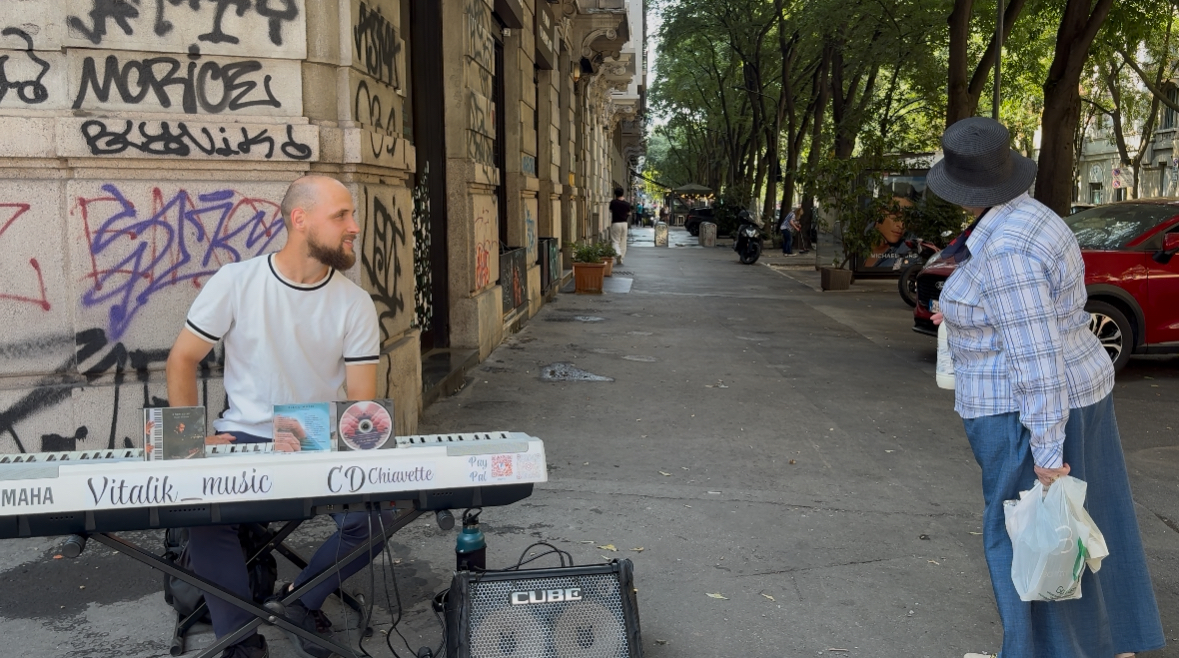
He told us that many of his relatives are still in Ukraine, between Kyiv and Lviv, and that he speaks with them often. His brother, meanwhile, is fighting on the front line. But even if he is not carrying a weapon himself, Vitalik does not see his role as any less important. “My duty is to stay here with my family, and my way of helping is through music,” he explains. And through music, Vitalik has found his own way of resisting. Every performance becomes more than entertainment: it is a moment of reflection, solidarity, and connection for many Ukrainians in Milan. Far from the battlefield, his piano still speaks of home, grief, hope, and perseverance.
